EXT-HD60M: 1080p HDMI Extender over CAT6 Explained
The EXT-HD60M sends 1080p@60Hz HDMI and IR up to 60m (196ft) over one CAT6/6a/7 cable, with a local HDMI loop-out on the transmitter. CAT5e won't…


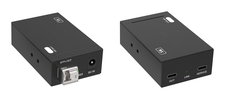 EXT-USBC4KFIB-10KM
Native USB-C DisplayPort Alt Mode 4K60 Extender over Fiber — 10G SFP+, up to 10km
Extend a USB-C Source Without Dongling to HDMI - Full 4:4:4, HDR Pass-Through, EDID from…
Product page →
EXT-USBC4KFIB-10KM
Native USB-C DisplayPort Alt Mode 4K60 Extender over Fiber — 10G SFP+, up to 10km
Extend a USB-C Source Without Dongling to HDMI - Full 4:4:4, HDR Pass-Through, EDID from…
Product page →
The EXT-USBC4KFIB-10KM is a point-to-point fiber-optic extender kit: a matched transmitter and receiver that carry a native USB-C DisplayPort Alt Mode video and audio signal from a source to a remote display. The source USB-C output plugs straight into the transmitter IN port, the signal travels over LC fiber on a 10G SFP+ module, and it arrives as native USB-C again at the receiver OUT port — no dongle at the source and no 100m copper ceiling. Both endpoints are compact black metal units, 3.19 × 1.93 × 0.98 in (81 × 49 × 25 mm) each, weighing 0.30 lbs (138 g).
The link runs up to 10km over single-mode fiber at 4K60, with OM4 multi-mode fiber supporting shorter, plant-matched runs instead, using a 10G SFP+ module with LC connectors at each end. The same transmitter and receiver serve either run — you swap the optic to match the fiber plant you already own, rather than changing extenders. SFP+ modules and fiber are selected to match the run and sold separately. The green LINK LED stays lit only when the transmitter and receiver have a good optical connection, so if it is off, check the LC fiber between the transmitter SFP+ OUT and the receiver SFP+ IN and confirm the run matches the fiber type in use.
Video bandwidth is 32.4 Gbps, supporting HBR3, HBR2, HBR and RBR at 8.1, 5.4, 2.7 and 1.62 Gbps. The link holds 4K at 60Hz in full 4:4:4 color, and resolution reaches up to 4096×2160p60/50, 3840×2160p60/50/30/25, 1920×1200p60RB, 1920×1080p60/50, 1280×720p60/50 and any VESA-standard resolution. Color space covers RGB, YCbCr 4:4:4/4:2:2 and YUV 4:2:0 at 8-bit, 10-bit or 12-bit depth. HDR10, HDR10+, Dolby Vision and HLG pass through, and audio includes LPCM, Dolby Digital/Plus/EX, Dolby TrueHD, Dolby Atmos, DTS, DTS-EX, DTS-96/24, DTS High Res, DTS-HD Master Audio and DTS:X — the same across the full reach the fiber type supports. HDCP 2.3, 2.2 and 1.x are supported.
EDID passes from the receiver back to the transmitter, so the source always reads the connected display's capabilities across the fiber run. If the picture is up but the resolution looks wrong, confirm the receiver is powered on with its POWER LED lit and that the display is connected to the receiver OUT port — with that path intact, the source can read the display over the link.
Each end has its own DC 5V/1A power input, fed by an included multinational supply rated AC 100–240V, 50/60Hz. The transmitter draws 2.7W maximum and the receiver 2.5W maximum. Both units contain sensitive electrical components that can be damaged by spikes, surges, shock or lightning, so a surge-protection device is highly recommended to protect and extend the life of the equipment. Each unit also carries a SERVICE port — a USB-C update port used for firmware updates. The kit is CE, FCC and UL certified, and rated for operation from 32°F to 104°F (0°C to 40°C).
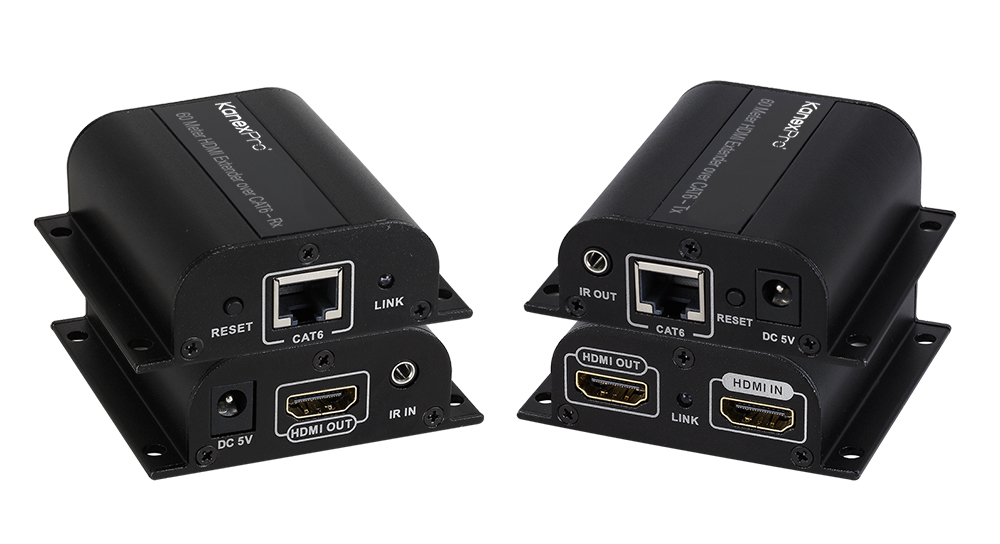
The EXT-HD60M sends 1080p@60Hz HDMI and IR up to 60m (196ft) over one CAT6/6a/7 cable, with a local HDMI loop-out on the transmitter. CAT5e won't…
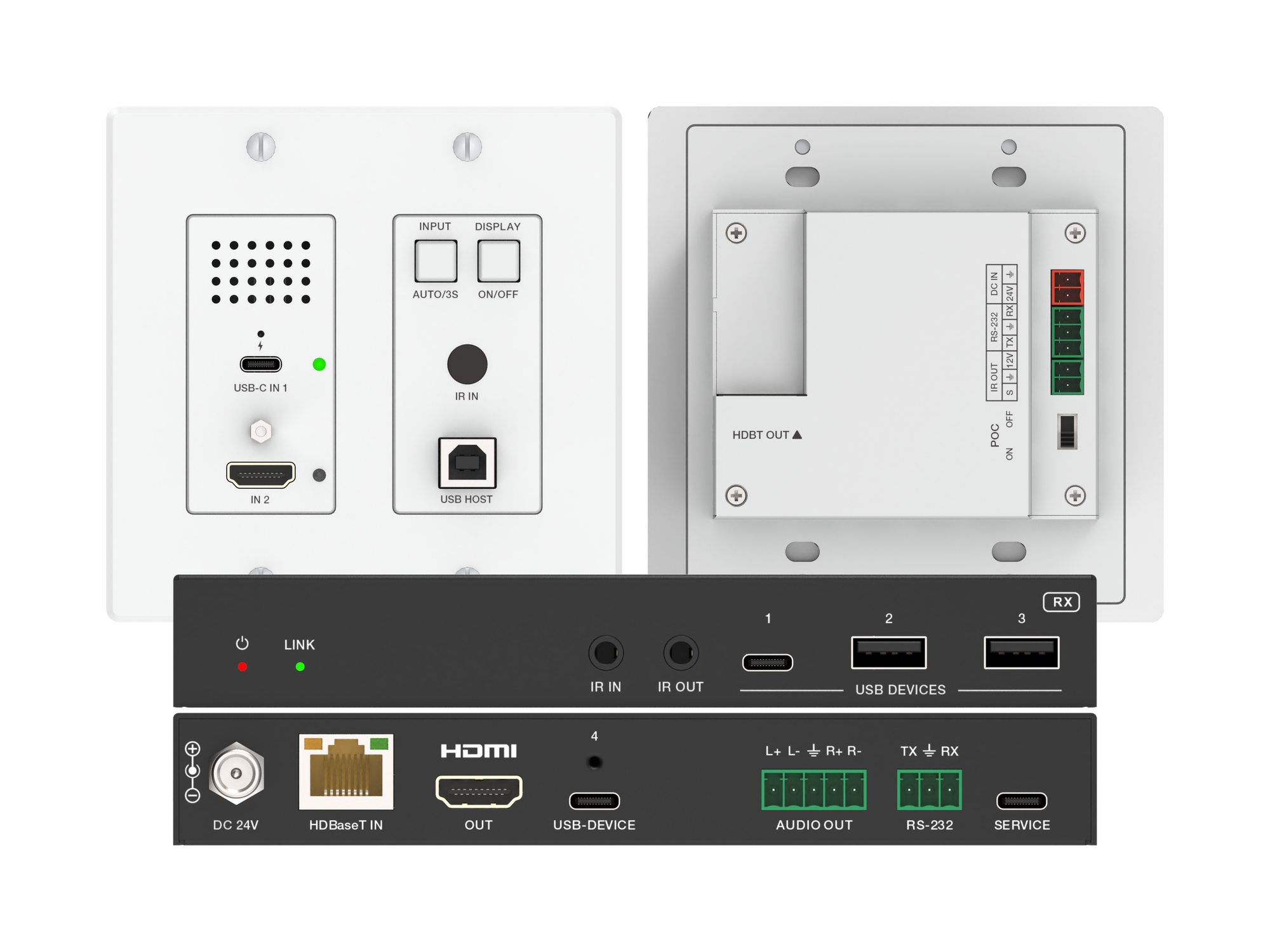
A 2-gang wall plate that sends laptop USB-C or HDMI video, USB 2.0 and 60W charging to a display up to 100m away over one CAT6/6A cable.
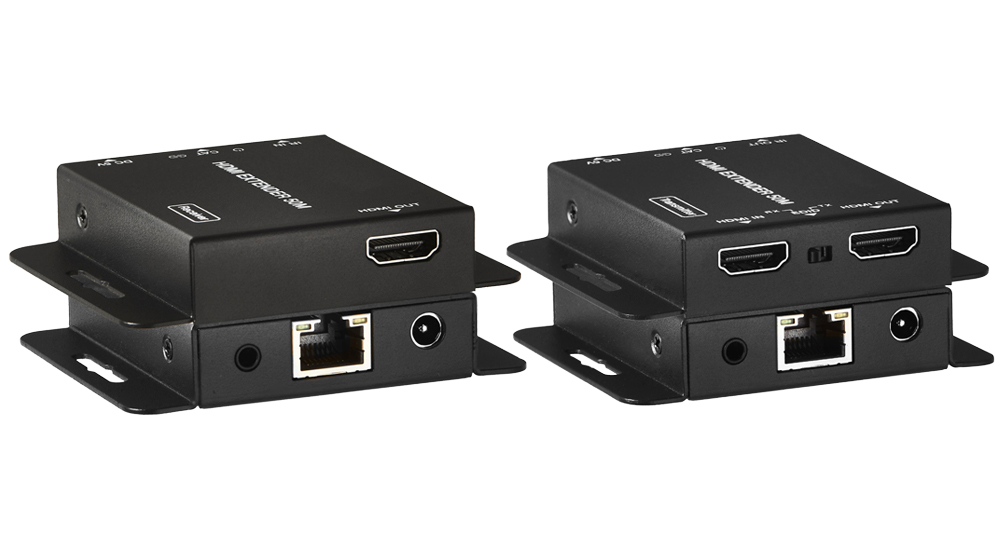
The EXT-HD50C sends HDMI over one Cat5e/6 run — 70M at 1080p or 40M at 4K@30Hz on Cat6 — with HDMI 1.4/HDCP 1.4 and loop-out.
KanexPro sells direct to dealers, resellers, installers and integrators, and through distribution. Whichever way you buy, the same engineers answer the phone.
The trade store: your own account, live stock, reordering, and a first look at new products.
Go to the trade store →Distribution and authorised resellers across the US and beyond.
See where to buy →Design help on extenders, matrix and AV over IP before you spec it.
Ask an engineer →