HDMI Distribution System Design: Splitters, Matrices, Scalers and Dante
Specifying an HDMI Distribution System: Splitters, Matrices, Scaling Switchers and Dante Audio Short answer: Choose the device by the shape of the…



Creating a network that requires high speeds and heavy bandwidth connections that require long distances requires the very best cables. While copper may be on your radar, fiber optic cables offer a variety of unique advantages when compared. Below you will find why pros choose fiber optic cables as there are a number of unique benefits.
Creating a cable infrastructure made up of fiber optic cables is an important investment. Alternative options do not compare in terms of quality and longevity. Consider the following benefits of fiber optic cables.
Bandwidth is the standard measurement for data transmission. It is measured in gigabytes (Gbps) or terabits (Tbps) per second. Fiber optic transmission is faster than alternative options as it can carry data at nearly the speed of light. Even more impressive, the bandwidth limit of fiber optic cables is theoretical due to how fast it is. However, testing does show that it travels at hundreds of terabits per second. To compare, copper-based transmissions have a maximum speed of 40 Gbps.
Fiber optic transmission can cover greater distances than alternative options. For example, copper signals are weaker at larger distances. However, fiber optic cables transmit data over vast distances. In fact, fiber optic cables can transmit more than 24 miles depending on the type of cable and signal. Copper cables, on the other hand, can only travel 330 feet.
Fiber optic cables are impervious to electromagnetic interference. Unlike copper, the light transmission in fiber optic cables does not generate any electromagnetic interference. This is advantageous as compared to copper. The electrical signaling in a network connection made of copper creates a field of interference. With this interference around the cables, especially if there are multiple cables near one another, it can impact the messaging.
The impact, often referred to as “crosstalk,” can risk your security and be very difficult to fix. Because fiber optic cables do not generate any electromagnetic interference, they are more secure and require less retransmission. Choosing fiber optic cables can result in saving both time and money.
The structure of fiber optic cable strands is very narrow. Commonly used fiber optic cables are similar to a human hair in terms of diameter. Because they are so small they are measured in “millionths” of a meter. While they do require a protective sheathing, it only increases their diameter to two millimeters. Comparatively, a copper cable is four times that size and carries much less data. Fiber optic cables take up much less space and offer many more advantages as compared to copper cables.
In addition to being much smaller and more effective than alternative options, fiber optic cables are much easier to manage. Computer labs, data centers, and even AV systems can be riddled with cables. The small size of fiber optic cables makes circulation much easier as less heat is generated. In addition, it is easier to manage the cables and it looks way more organized.
Modern technology moves quickly and this has especially been true over the last decade. Fiber optic cables not only operate with technology right now, but they will function at future speeds without needing to be replaced. Experts project that this cable technology will function well into the future and the cables themselves can last up to decades before they need to be replaced. To maximize your cables, consider HDMI fiber optic extenders. Investing in the right infrastructure from the beginning can save you a lot of time and money in the long run.
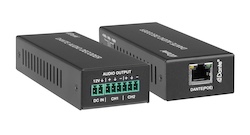
Specifying an HDMI Distribution System: Splitters, Matrices, Scaling Switchers and Dante Audio Short answer: Choose the device by the shape of the…
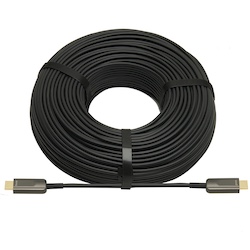
If your source is component video (the red, green, and blue RCA connectors), you need a component to HDMI converter. If it is composite video (a…
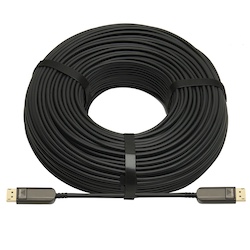
DisplayPort beats HDMI for high-refresh PC monitors and daisy-chaining; HDMI is the pick for TVs, consoles and projectors, and USB-C for laptops.
KanexPro sells direct to dealers, resellers, installers and integrators, and through distribution. Whichever way you buy, the same engineers answer the phone.
The trade store: your own account, live stock, reordering, and a first look at new products.
Go to the trade store →Distribution and authorised resellers across the US and beyond.
See where to buy →Design help on extenders, matrix and AV over IP before you spec it.
Ask an engineer →