HDMI Distribution System Design: Splitters, Matrices, Scalers and Dante
Specifying an HDMI Distribution System: Splitters, Matrices, Scaling Switchers and Dante Audio Short answer: Choose the device by the shape of the…



HDMI cables are an integral part of nearly every home and office. They serve as an important piece of tech as they deliver both audio and visual images from a source to a display. Depending on your unique needs, you may wonder, how long can an HDMI cable be? Below, you will find more information on HDMI cables and their potential capabilities in terms of length.
The maximum length of an HDMI cable depends on a number of factors. From the cable quality to what it’s specifically designed for, lengths can vary. There is no specific limit in terms of how long a cable can be. However, there are potential drawbacks to using longer HDMI cables. This is because as the length increases, the signal can also diminish. Signal loss due to attenuation is common in really long HDMI cables.
When considering an HDMI cable that is longer, it’s important to understand the cable’s American Wire Gauge (“AWG”) rating. The AWG rating determines the ability of the cable to deliver quality audio and video over long distances. The lower the AWG rating, the thicker the cable. Thicker cables are inevitably better at delivering high-resolution signals over longer distances.
There are various types of HDMI cables, and each has a different maximum length. Consider the following types of cables and their respective maximum lengths.
Passive HDMI cables have a maximum range of roughly 25 feet. Beyond this length, signal degradation often occurs. However, optimal conditions can reduce the impact of interference. If you need your HDMI cable to reach longer distances, consider an active HDMI cable or a cable that utilizes fiber optic technology.
Active optical HDMI cables have a maximum range of up to 100 feet. This is a great option if you need a lengthy connection. Common reasons why you may need a longer HDMI cable include home theaters or ceiling-mounted projectors. If you need something longer than this, consider an HDMI extender. HDMI extenders are helpful if an HDMI cable alone won’t suffice.
Many people like to use 4K resolution for their home entertainment systems. It allows you to effectively enjoy watching movies and playing games. The best HDMI cable for this is an HDMI 2.0 or 2.1 cable. This ensures better features, a higher refresh rate, and HDR support as compared to HDMI 1.4 cables. HDMI 2.0 and 2.1 cables can reach up to 50 feet if you choose a fiber optic active cable. This is generally enough for home entertainment systems.
Most HDMI cables support 1080p resolution. However, HDMI 2.0 and 2.1 cables offer the best quality for this resolution. They can reach up to 30 feet on their own. This is great for practical use at home or at work. If you want more length, consider fiber optic HDMI 2.1 cables/ as they offer a number of additional benefits.
When you need your HDMI connection to reach very long distances, consider an HDMI extender. An HDMI cable alone won’t work, as signal instability can occur. In addition to signal instability, you may encounter screen flashing or other issues. An HDMI extender can reach signals up to 300 feet by compressing the signal and transmitting it over an Ethernet cable. A fiber optic-based extender can reach even longer distances. In fact, it can reach a distance of up to 1,000 feet. If you need to reach long distances with your HDMI cable, contact Kanex Pro for support. They offer a number of audio-visual products that can meet your unique project needs.
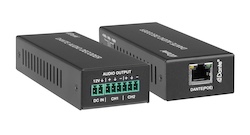
Specifying an HDMI Distribution System: Splitters, Matrices, Scaling Switchers and Dante Audio Short answer: Choose the device by the shape of the…
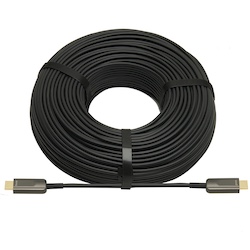
If your source is component video (the red, green, and blue RCA connectors), you need a component to HDMI converter. If it is composite video (a…
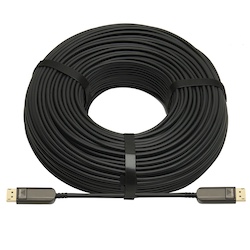
DisplayPort beats HDMI for high-refresh PC monitors and daisy-chaining; HDMI is the pick for TVs, consoles and projectors, and USB-C for laptops.
KanexPro sells direct to dealers, resellers, installers and integrators, and through distribution. Whichever way you buy, the same engineers answer the phone.
The trade store: your own account, live stock, reordering, and a first look at new products.
Go to the trade store →Distribution and authorised resellers across the US and beyond.
See where to buy →Design help on extenders, matrix and AV over IP before you spec it.
Ask an engineer →