One USB-C Cable at the Table for Video, USB Devices and 60W Charging
How one 2-gang wall-plate carries laptop video, USB camera and mic, and 60W charging to a distant display over a single CAT6/6A run.


In a large lecture hall, a long sanctuary, a courtroom or a divisible ballroom, the source wall and the display are simply too far apart for an ordinary extender plate. The run — not USB reach, not KVM — is what defeats the hardware. A shorter-reach plate runs out of cable before it reaches a rear projection booth, an attic-mounted projector or a far LED wall, and the picture is where the compromise shows first: chroma gets subsampled, fine text softens, and a spreadsheet or an evidence document stops being legible at range.
The usual answer to distance is to put the signal on the network — an encoder, a decoder and a managed switch to commission. That buys reach, but it also buys a codec pair to configure, a VLAN to argue over with IT, and a compression stage in the path. For a single source-to-display run in a room that has no reason to touch the LAN, that is a lot of infrastructure to own for one link.
These rooms also mix source types. A lectern or presenter position now has to take a resident room PC on HDMI and a visiting laptop on USB-C, and switch between them without a control-system macro babysitting every changeover.
The WP-EXTHDTC150 carries an uncompressed 4K60 4:4:4 signal from a wall plate to a display up to 120m over a single CAT6/6A cable, with no AV-over-IP encoder, decoder or network switch to commission. The link passes 18Gbps of HDMI 2.0b video and is HDCP 2.2 compliant. Reach runs to 120m (394ft) at 4K2K@60Hz 4:4:4 via CAT6/6A, and to 150m (492ft) at 1080p@60Hz via CAT6/6A — the run length is the design point, and it holds 4:4:4 color the whole way.
The transmitter is a 1-gang US-size wall plate with two inputs, one HDMI and one USB-C, with automatic or manual switching between them. It passes HDR, HDR10, HDR10+, Dolby Vision and HLG intact, along with LPCM 7.1, Dolby TrueHD and DTS-HD Master Audio, and supports 8-bit, 10-bit and 12-bit color depth across RGB 4:4:4, YCbCr 4:4:4, YCbCr 4:2:2 and YCbCr 4:2:0. The compact box receiver drives the display over HDMI OUT and de-embeds analog stereo on a 3.5mm output for a local audio tie-in. Bi-directional IR, RS-232 and CEC pass through the cable so the control system can operate source and display from either end, and bi-directional PoC lets either end power the other over the CAT run.
A lectern input plate takes both a resident room PC on HDMI and a visiting laptop on USB-C with auto-switching, and drives a projector at the rear booth over one CAT6A run. Full 4:4:4 keeps fine text and spreadsheet legibility intact at range, and bi-directional RS-232 and CEC let the control system power the projector from the lectern.
The stage-side confidence and program feed originates at a wall plate and reaches a projection booth or overflow display across a long sanctuary. HDR10+/Dolby Vision and Dolby TrueHD/DTS-HD Master Audio pass-through preserve the produced look and the multichannel bed at the far endpoint, with no IP backbone or codec pair to commission.
A counsel-table or podium input plate feeds evidence displays and the bench at a building-length distance under a fixed, documented signal path. Straight-through single-cable transport and RS-232 control suit a chambers standard that avoids network dependencies, and the receiver's de-embedded analog stereo feeds a court-reporting or assistive-listening tie-in.
A floor-box or column input plate drives ceiling projectors or a far LED wall across a large divisible ballroom. The 120m reach at 4K60 4:4:4 covers the longest single-room throws these venues generate, and bi-directional PoC lets the installer power whichever end is easier to reach with AC behind a fixed wall or up in a rigging grid.
A presenter position takes HDMI and USB-C laptops and sends a single uncompressed 4K feed to a distant display or projector in a tall, open floorplate where an in-wall home-run is cleaner than a switch drop. Auto-switching handles presenter changeovers without a control-system macro.
A media-room or great-room input plate feeds a projector in a remote booth or an attic-mounted unit at the far end of a large home. Dolby Vision and lossless-audio pass-through keep the cinema pipeline intact, and the 1-gang plate keeps the source wall architecturally clean.
Confirm the run against the resolution it has to carry: up to 120m/394ft at 4K2K@60Hz 4:4:4 via CAT6/6A, or up to 150m/492ft at 1080p@60Hz via CAT6/6A. Use a single CAT6/6A cable between the transmitter's HDBaseT OUT and the receiver's HDBT IN, terminated straight-through — both ends wired to the same pin order; do not cross-connect. The WP-EXTHDTC150 ships with a 24V/1A multinational power supply (input AC 100–240V, 50/60Hz); the transmitter draws 4.5W max and the receiver 4.7W max. With bi-directional PoC, powering either unit from the adapter powers the other over the CAT cable. The kit also includes a 1.5m IR blaster cable and a 1.5m IR wideband receiver cable. The unit is rated to IEC 61000-4-2 for ESD (±8kV air-gap, ±4kV contact) in a metal enclosure, and the manual strongly recommends installing surge protection on the link.
No. The transmitter and receiver each connect directly to one CAT6/6A run, with no LAN switch, encoder or decoder required between them.
Up to 120m/394ft at 4K2K@60Hz 4:4:4 via CAT6/6A, and up to 150m/492ft at 1080p@60Hz via CAT6/6A. It carries 18Gbps of HDMI 2.0b video and is HDCP 2.2 compliant.
Either. Bi-directional PoC means connecting the 24V/1A adapter at one end powers the other over the CAT cable, provided the transmitter's PoC switch is set to ON. If PoC is OFF, the far unit needs its own local supply.
Yes. The link passes HDR, HDR10, HDR10+, Dolby Vision and HLG, along with LPCM 7.1, Dolby TrueHD and DTS-HD Master Audio, and de-embeds analog stereo at the receiver for a local tie-in.
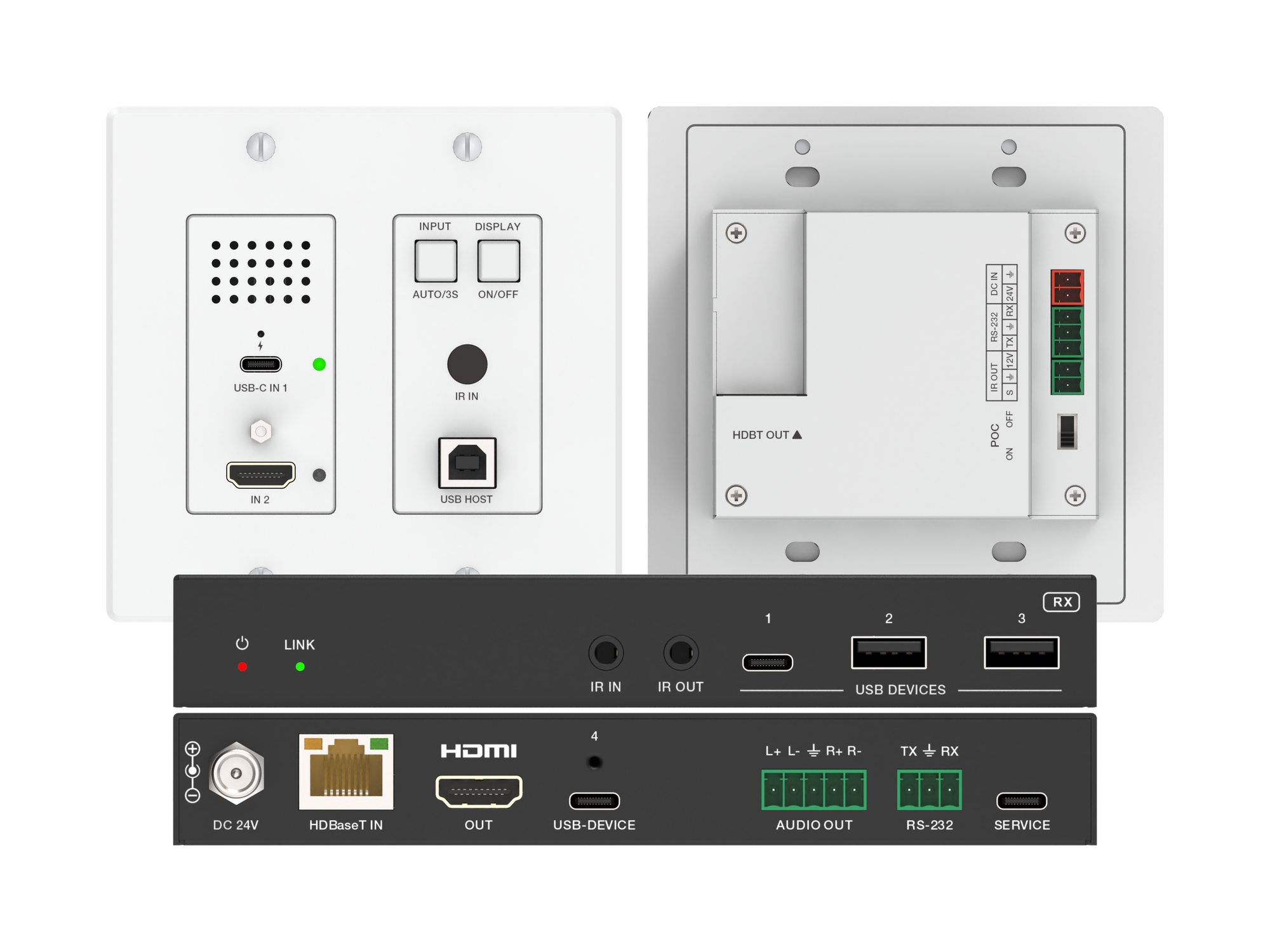
How one 2-gang wall-plate carries laptop video, USB camera and mic, and 60W charging to a distant display over a single CAT6/6A run.
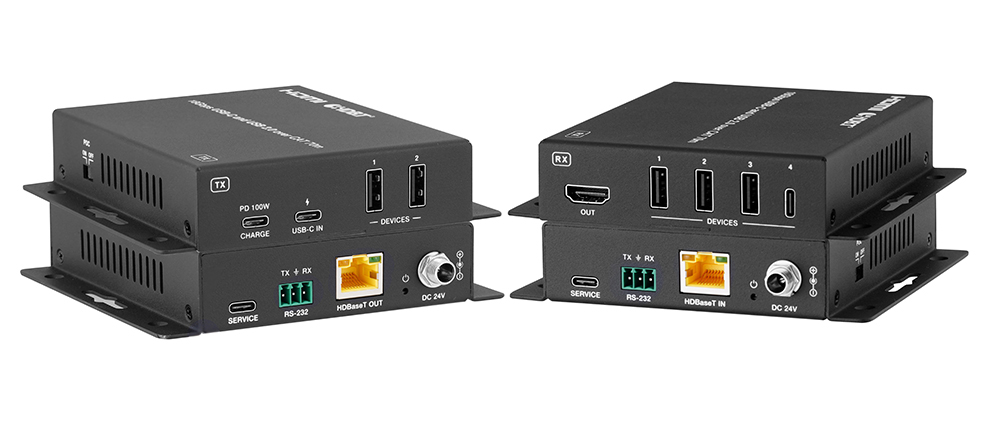
A BYOD room gets designed around the display, the room camera, and the network — and then the actual connection between the laptop and all of it is…
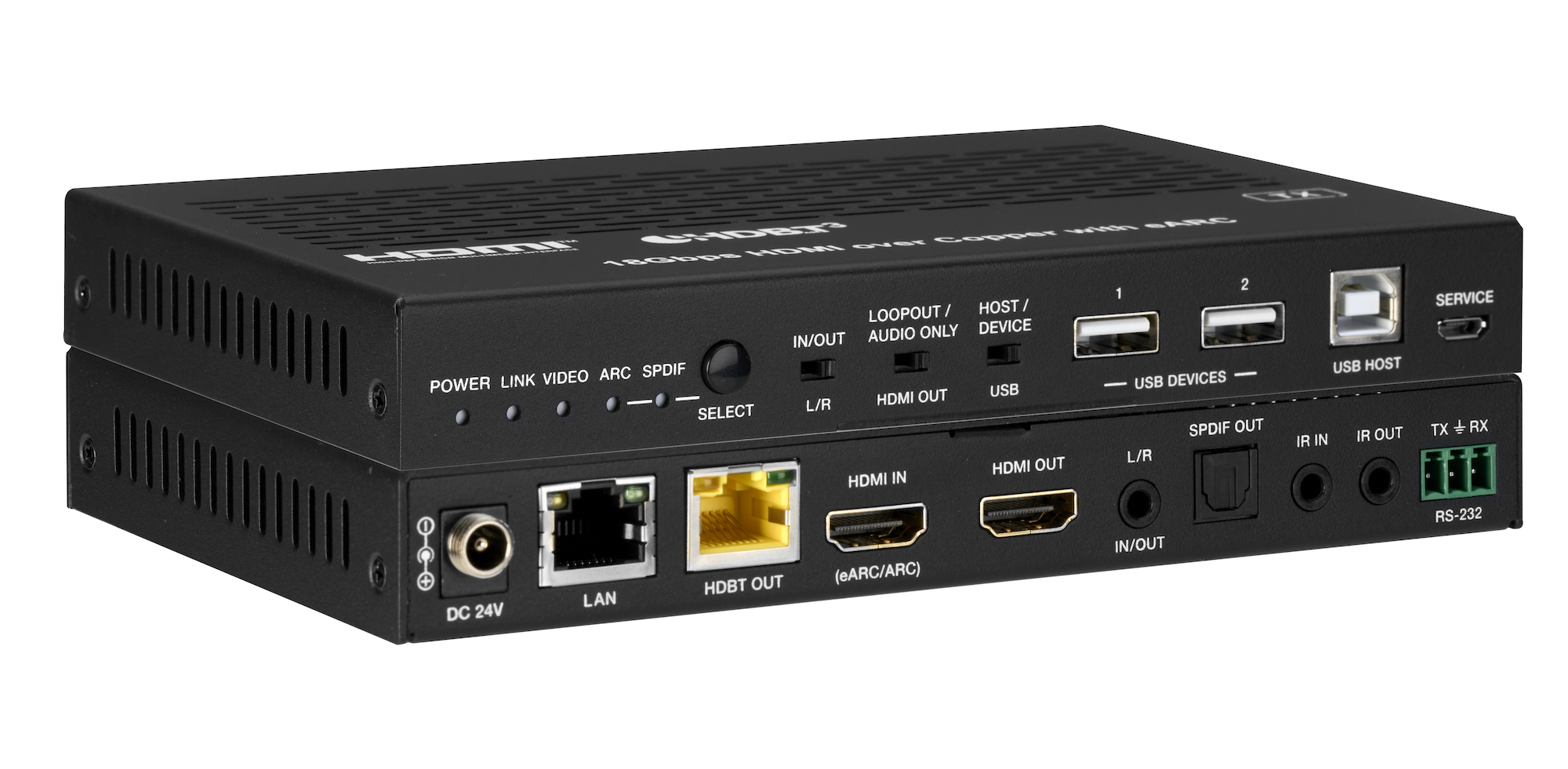
How the EXT-HDBT3ARC-TX carries 4K60 video out to the display and brings eARC audio back down the same CAT6A cable, with USB 2.0, Gigabit Ethernet…
KanexPro sells direct to dealers, resellers, installers and integrators, and through distribution. Whichever way you buy, the same engineers answer the phone.
The trade store: your own account, live stock, reordering, and a first look at new products.
Go to the trade store →Distribution and authorised resellers across the US and beyond.
See where to buy →Design help on extenders, matrix and AV over IP before you spec it.
Ask an engineer →