Component, Composite, and DVI to HDMI Converters: Which One Do You Need
If your source is component video (the red, green, and blue RCA connectors), you need a component to HDMI converter. If it is composite video (a…



If you have been in the pro AV world for any length of time, you know how fast things change. What worked perfectly for a client three years ago might already feel outdated today. And right now, one of the biggest shifts happening across installations from corporate boardrooms to broadcast studios is the move toward the flex modular matrix switcher.
But what exactly is it? Why are experienced installers ditching their old fixed matrix setups for this newer approach? And is it the right choice for your next project?
Before we get into the flex side of things, let's quickly cover the basics.
A matrix switcher is essentially the traffic controller of an AV system. It takes multiple input sources think laptops, cameras, media players, or computers and lets you route any of those inputs to any output display or destination you choose, all at the same time.
So if you have a meeting room with four different presentation sources and six displays, a matrix switcher lets you send any source to any screen, instantly. That is the core job.
Traditional matrix switchers do this job well. But they come with one big limitation: they are fixed. You buy a 4x8 matrix switcher, and you have four inputs and eight outputs forever. If your client's needs grow, you are buying a whole new unit.
A flex modular matrix switcher is a chassis-based system where the inputs and outputs are not locked in at the factory. Instead, the system is built around a central chassis frame, and you populate it with individual cards- one card for HDMI inputs, another for HDBaseT outputs, maybe one for AV over IP, and so on.
Think of it like a desktop computer. The case is the chassis. The cards are like your components- you pick what goes in based on what you actually need.
That is exactly the problem the flex matrix switcher was built to solve.
The three main building blocks are:
Flex Chassis — This is the brain and backbone. It handles power, signal processing, and routing. It stays in your rack for years.
Flex Cards — These are the interchangeable input and output modules. Need HDMI inputs? Slot in an HDMI card. Client wants HDBaseT outputs for long cable runs? There is a card for that too. Mix and match as needed.
Flex Extend Modules — Found in Pro-level systems, these add extended signal reach and more advanced routing capabilities for larger or more demanding installations.
The result? A single platform that can be configured for almost any project, and reconfigured when that project evolves.
Here is where it gets practical. Let's say you are comparing a traditional fixed matrix switcher against a flex matrix switcher for a client proposal.
With a traditional matrix switcher, what you buy is what you get. The signal type is fixed, the I/O count is fixed, and when the client outgrows it, the whole unit gets replaced. It works fine for stable, predictable environments but those are increasingly rare.
With a flex matrix switcher, the chassis stays put and the cards do the heavy lifting. Need to add more inputs six months after installation? Add a card. Client wants to shift from HDMI to AV over IP distribution? Swap the cards. Upgrading to 4K? New cards handle it without touching the chassis.
It is a fundamentally different mindset building for change rather than building for a fixed moment in time.
Honestly, the shift has been building for a few years. But in 2026, it has hit a tipping point. Here is what is driving it.
Installations are getting more complicated. A modern AV deployment is not just HDMI cables and a projector anymore. You have got 4K signals, HDR content, long-distance extension, AV over IP networks, and control system integration all happening in the same rack. A flex matrix handles all of that within one chassis instead of stacking three or four separate devices to get the same result.
Clients keep changing their minds. And honestly, who can blame them? Business needs shift, spaces get repurposed, teams grow. A flex matrix switcher means you are not locked into a configuration that made sense in January but feels limiting by July. You can adapt without a full rip-and-replace.
Hybrid work is not going away. Conference rooms in 2026 need to juggle local displays, remote participants, wireless presentation, and video conferencing all at once. The flex matrix makes it straightforward to route the right signal to the right place and change it on the fly.
The ROI conversation has gotten easier. When you can tell a client that the chassis they buy today will still be useful five years from now and that upgrades mean buying a card, not a whole new system- that is a compelling pitch. It saves money and reduces downtime during upgrades.
Audio matrix switching is part of the picture too. A good flex matrix system does not just handle video. It handles audio matrix switching as well, meaning audio signals can be routed independently from video. You can send audio to a different zone, manage multiple audio sources, or set up audio-follows-video scenarios- all within the same system. That kind of flexibility used to require a separate audio matrix switcher. Now it is built in.
You will find them in just about every serious AV environment right now:
Corporate boardrooms and executive suites — Routing presentation sources to displays, video walls, and conferencing endpoints without breaking a sweat.
Command and control rooms — Where operators need to pull any feed onto any screen at any moment, with zero tolerance for lag or failure.
University lecture halls and classrooms — Distributing content from instructors, remote guests, and collaborative tools across multiple displays.
Broadcast and production studios — Switching between camera feeds, graphics, and output channels in real time, with frame-accurate reliability.
Hotels and hospitality venues — Managing content across lobby displays, meeting rooms, restaurants, and event spaces from a central location.
Not all flex matrix switchers are built the same. Here is what to actually check before you spec one into a project:
Chassis slot capacity — How many cards can it hold? Always build in room to grow. Buying a chassis that is already full on day one is a mistake you will feel later.
Supported card types — Make sure the platform has cards for the signal types you need today and the ones you might need tomorrow. HDMI, HDBaseT, fiber, AV over IP — these should all be options.
4K and HDR support — In 2026, this is non-negotiable. Look for 4K60 at 4:4:4 with HDR10 support at minimum.
Control system compatibility — RS-232, TCP/IP, and support for Crestron, AMX, or Extron control systems is essential for most commercial installations.
Audio matrix switcher functionality — Confirm independent audio routing is supported, not just audio-follows-video.
Manufacturer support — Firmware updates, tech support availability, and warranty terms matter a lot when something goes sideways mid-installation.
Q: What is the difference between a matrix switcher and a flex matrix switcher?
A regular matrix switcher has a fixed number of inputs and outputs baked in at the factory — you cannot change them. A flex matrix switcher uses a modular card system inside a chassis, so you can add, remove, or swap cards to change the I/O configuration whenever you need to.
Q: Can a flex matrix switcher handle both audio and video?
Yes. Many flex matrix platforms include audio matrix switching capabilities, letting you route audio signals independently from video. This means you can send audio to a separate zone, mix multiple sources, or keep audio locked to a specific video signal — all in one system.
Q: Is a flex modular matrix switcher worth it for a small installation?
Absolutely. You can start small — a compact chassis with just a few cards — and grow from there. It is actually one of the best arguments for going modular even on smaller projects, because you are not locked into a fixed system that might not fit six months from now.
Q: Does a flex matrix switcher support 4K?
Yes, modern flex matrix switchers support 4K60 with HDR. Just make sure the specific cards you are using are rated for the resolution and color depth your project requires.
Q: How do you control a flex matrix switcher?
Most systems support front panel control, a web-based interface, RS-232, and TCP/IP. That means they integrate cleanly with third-party control systems and can also be managed remotely over a network.
Q: How is it different from AV over IP?
They solve different problems. A flex matrix switcher gives you ultra-low-latency, deterministic signal switching — ideal for control rooms, live events, and broadcast. AV over IP shines in large distributed environments where running cables back to a central chassis is not practical. Many flex matrix platforms actually support AV over IP cards, so you can combine both approaches in the same system.
Q: How do I pick the right chassis size?
Count your current inputs and outputs, then add about 25-30% for growth. A slightly larger chassis upfront is almost always cheaper than replacing the whole system when you outgrow a smaller one.
The flex modular matrix switcher is not just a new product category — it is a smarter way to approach AV system design. Instead of buying for today and hoping nothing changes, you are building a platform that can evolve as fast as your clients' needs do.
For pro AV installers, that means fewer rip-and-replace jobs, happier clients, and a much easier upgrade conversation. For end users, it means a system that actually keeps pace with how they work — in 2026 and well beyond.
KanexPro's Flex Matrix and Flex Matrix Pro lines are built exactly for this kind of professional deployment. If you are speccing your next installation and want to talk through the right configuration, our team is here to help.
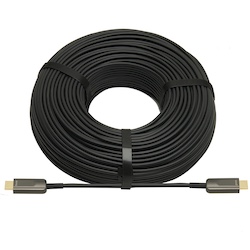
If your source is component video (the red, green, and blue RCA connectors), you need a component to HDMI converter. If it is composite video (a…
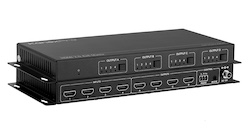
If you searched something like "matrix switchers," "HDMI matrix switcher," or "audio matrix switcher" to land here, you're almost certainly stuck on…
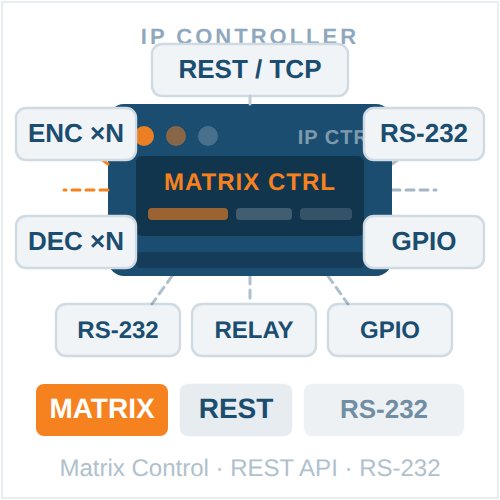
Every Second Matters in a Hospital - So Does Communication Walk into any modern hospital and you'll immediately notice something beyond the doctors…
KanexPro sells direct to dealers, resellers, installers and integrators, and through distribution. Whichever way you buy, the same engineers answer the phone.
The trade store: your own account, live stock, reordering, and a first look at new products.
Go to the trade store →Distribution and authorised resellers across the US and beyond.
See where to buy →Design help on extenders, matrix and AV over IP before you spec it.
Ask an engineer →