USB-C to USB-C Extender: 4K60, Data & 100W over CAT6a
The EXT-USBC2C4K-40M carries USB-C video, USB 3.2 data, touch return and 100W charging up to 40m over one CAT6a cable at 4K.


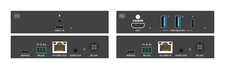 EXT-USBCPD4K-40M
4K60 USB-C Extender Kit with USB 3.2, 100W Charging and HDMI Output, 40m
Single-Cable BYOD: DP Alt Mode Video, USB 3.2 Gen 1 Data and 100W Power Delivery over CAT6a to…
Product page →
EXT-USBCPD4K-40M
4K60 USB-C Extender Kit with USB 3.2, 100W Charging and HDMI Output, 40m
Single-Cable BYOD: DP Alt Mode Video, USB 3.2 Gen 1 Data and 100W Power Delivery over CAT6a to…
Product page →
The EXT-USBCPD4K-40M is a two-piece transmitter-and-receiver kit that takes one full-featured USB-C port on a laptop and delivers video, USB peripheral data and laptop charging to a remote display over a single CAT6a cable. The transmitter accepts DisplayPort Alt Mode 1.4a video, USB 3.2 Gen 1 and USB 2.0 data, and USB-C Power Delivery 3.0; the receiver breaks that back out to an HDMI display, USB peripherals and de-embedded audio at the far end. It is built for BYOD meeting rooms and presentation spaces where a presenter should plug in once and have the room come up.
It extends a full USB-C signal — DP Alt Mode 1.4a video, USB 3.2 Gen 1 data and up to 100W PD charging — from one laptop port to a remote receiver. At the display end the receiver provides an HDMI 2.0b output rated to 18Gbps with HDCP 2.3 and HDCP 1.x, three downstream USB ports, a 3.5mm de-embedded analog audio output, and RS-232 pass-through. The result is one cable to the wall plate that carries the picture, the room's USB devices and power for the laptop at the same time.
The link between transmitter and receiver reaches up to 40m/130ft at 4K and up to 35m/115ft at 5K, over CAT6a U/FTP, 23AWG minimum, direct-wired. The cable must be a straight-through connection terminated to the same pinout at both ends — do not cross-connect. Over HDMI the kit passes resolutions from 480i up to 4096x2160@60, plus ultrawide modes 2560x1080@60, 3440x1440@60 and 5120x1440@50/60, and 5120x2160@50/60 (5K60 at 4:2:2/4:2:0, 8-bit). It also passes HDR, HDR10, HDR10+, Dolby Vision and HLG, at 8/10/12-bit color across RGB and YCbCr 4:4:4, 4:2:2 and 4:2:0. Note the two local cables have their own limits: the USB-C source cable is 1.5m/4.9ft (USB 3.2 Gen 1 passive) and the HDMI output cable is 3m/9.8ft passive.
The receiver offers one HDMI Type A output to the display, two downstream USB-A ports and one downstream USB-C port (5V/1.5A each) for cameras, speakerphones, touch panels or storage, and a 3.5mm AUDIO OUT for de-embedded LPCM 2CH audio. Its RJ45 AV-USB3 IN carries the AV and USB signals plus 24V PoC back to the transmitter. USB runs at up to 2.5 Gbps (USB 3.2 Gen 1; 5 Gbps operation is not supported).
The transmitter is powered from its included 24V/7.5A supply. The receiver runs on 24V PoC over the CAT6a cable, or from an optional 24V/2A supply, and the PoC is bi-directional so the far end needs no supply of its own. Up to 100W USB-C Power Delivery flows back to the laptop over the same USB-C cable — but only when the transmitter is powered from its 24V/7.5A supply. Both boxes are metal enclosures with mounting ears and IEC 61000-4-2 ESD protection (±8kV air-gap, ±4kV contact), and a surge-protection device is recommended on the cable run.
Control is available two ways: RS-232 pass-through on a 3-pin 3.5mm phoenix connector at both ends, and an ASCII API over the USB-C SERVICE port at 115200 baud, 8 data bits, 1 stop bit, no parity. Over the API you can set input and output HDCP mode, choose from 25 EDID presets (two user-defined), set the output source, control HDMI 5V and downstream USB port power, read status and signal, and reboot, reset or update firmware.
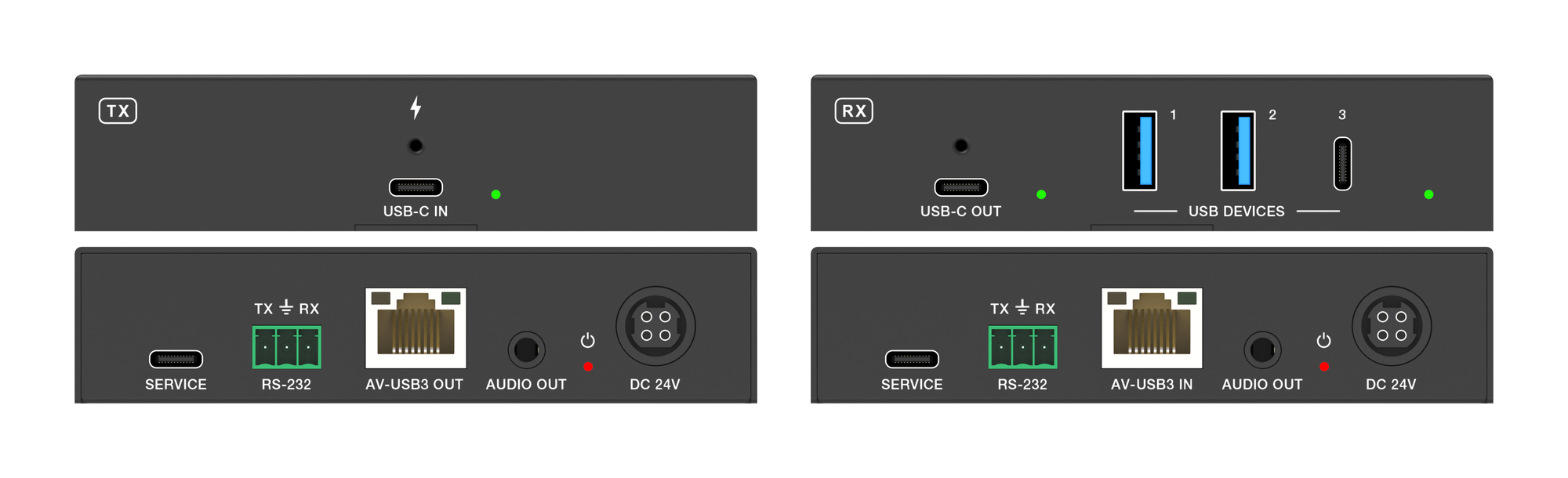
The EXT-USBC2C4K-40M carries USB-C video, USB 3.2 data, touch return and 100W charging up to 40m over one CAT6a cable at 4K.
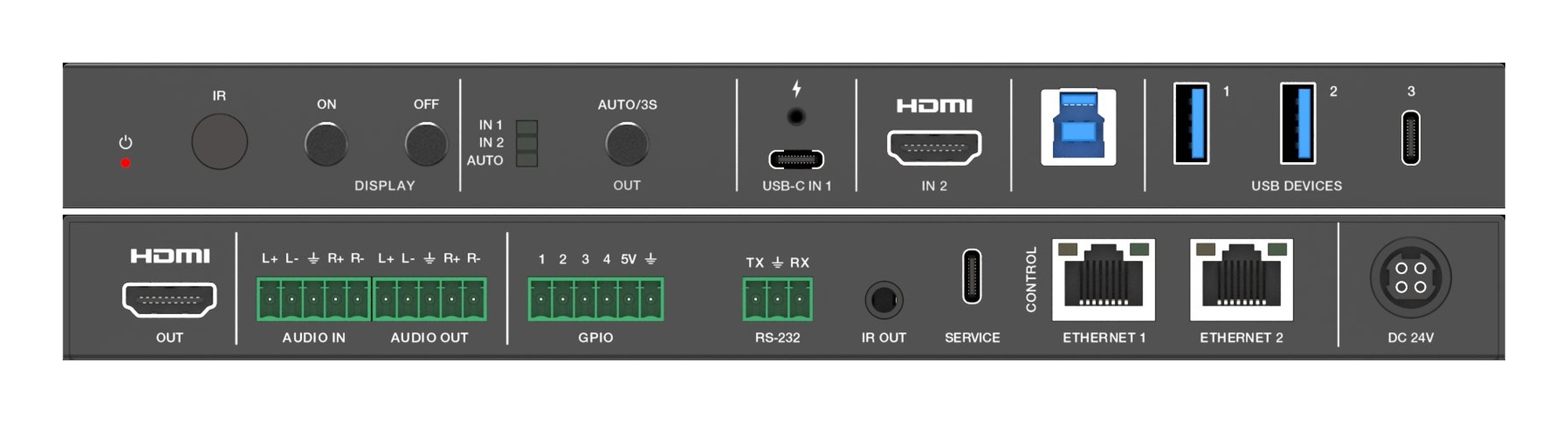
Overview This guide covers physical installation of KanexPro Collaboration products — Huddle Room switchers, Presentation switchers, and Video Wall…
General What is the difference between the Huddle Room, Presentation, and Video Wall subcategories? Huddle Room switchers (COL-HUD series) are…
KanexPro sells direct to dealers, resellers, installers and integrators, and through distribution. Whichever way you buy, the same engineers answer the phone.
The trade store: your own account, live stock, reordering, and a first look at new products.
Go to the trade store →Distribution and authorised resellers across the US and beyond.
See where to buy →Design help on extenders, matrix and AV over IP before you spec it.
Ask an engineer →