Downloading KanexPro software and firmware safely
How KanexPro checks firmware and software downloads, how to verify a file's SHA-256 fingerprint, what the Windows SmartScreen warning means, and…


AV over IP relies on a properly configured managed network switch to function correctly. This article covers the essential switch settings required for stable, high-quality IP video distribution across all KanexPro AV over IP codec families (JPEG2000, H.265, SDVoE).
Important: Unmanaged switches are not supported. All encoders and decoders must connect to a managed switch with the settings below applied.
IGMP (Internet Group Management Protocol) snooping must be enabled on the switch. AV over IP uses multicast for one-to-many distribution — without IGMP snooping, multicast traffic floods every port on the switch, saturating bandwidth and causing dropped frames or no signal.
Recommended switches: Cisco SG350/SG550 series, Netgear M4250, Cisco Catalyst 9000 series.
JPEG2000 and SDVoE streams use large packet sizes. Enable jumbo frames (9000-byte MTU) on all switch ports connected to encoders and decoders. Failure to enable jumbo frames may result in degraded video quality or intermittent signal loss.
Disable flow control (IEEE 802.3x) on all switch ports connected to AV over IP devices. Flow control can cause buffering and latency spikes in real-time video streams.
Isolating AV traffic on a dedicated VLAN prevents interference from corporate data traffic and simplifies network management.
Encoders and decoders must be on the same IP subnet as each other and as the IP controller's VIDEO LAN port. KanexPro controllers have a second port, CONTROL LAN, for the IT network or control PC. On the H.265 and SDVoE controllers, the VIDEO LAN subnet must differ from the CONTROL LAN subnet when Static mode is used.
| Codec | Resolution | Bandwidth per Stream | Network Required |
|---|---|---|---|
| JPEG2000 | 4K60 | 1G per stream | 1G (1 stream per port) |
| H.265 | 4K60 | Set by the encoder's bitrate type and image quality settings | 1G (multiple streams per port possible) |
| H.265 | HD 1080p60 | 8 Mbps main + 1 Mbps sub stream (defaults, configurable) | 1G |
| SDVoE | 4K60 | Uncompressed; 10G link per endpoint | 10G (dedicated port per stream) |
For JPEG2000 systems, use a non-blocking switch with sufficient backplane capacity for all simultaneous streams. A 24-port 1G switch for 12 encoders and 12 decoders should be non-blocking.
JPEG2000: the AVO-IPJP2K and AVO-IPJP2KD ship in unicast (CA1), which sends one stream to one display. Set multicast when several displays show the same source: CA2 on the front-panel configuration page (the unit reboots), the casting mode on the AVO-IPJP2KD web GUI's Network page, or Transmission Mode on the AVO-IPCTL-JP2K Device page. Keep KVM roaming pairs in unicast, because multicast mode does not support KVM.
1080p H.265: the AVO-IP265HD-DEC defaults to UDP multicast; UDP unicast can be selected as the Transmission Protocol on the decoder's Video Configuration page.
SDVoE: point-to-point links work without a controller; matrix switching, video wall and multiview require the AVO-IPCTL-SDV. In either case, enable IGMP snooping, multicast and filtering of unregistered multicast traffic on the 10G switch.
How KanexPro checks firmware and software downloads, how to verify a file's SHA-256 fingerprint, what the Windows SmartScreen warning means, and…
Boardrooms, conference rooms, campuses, lobbies — real-world deployment scenarios Corporate AV is among the most practical deployment target for…
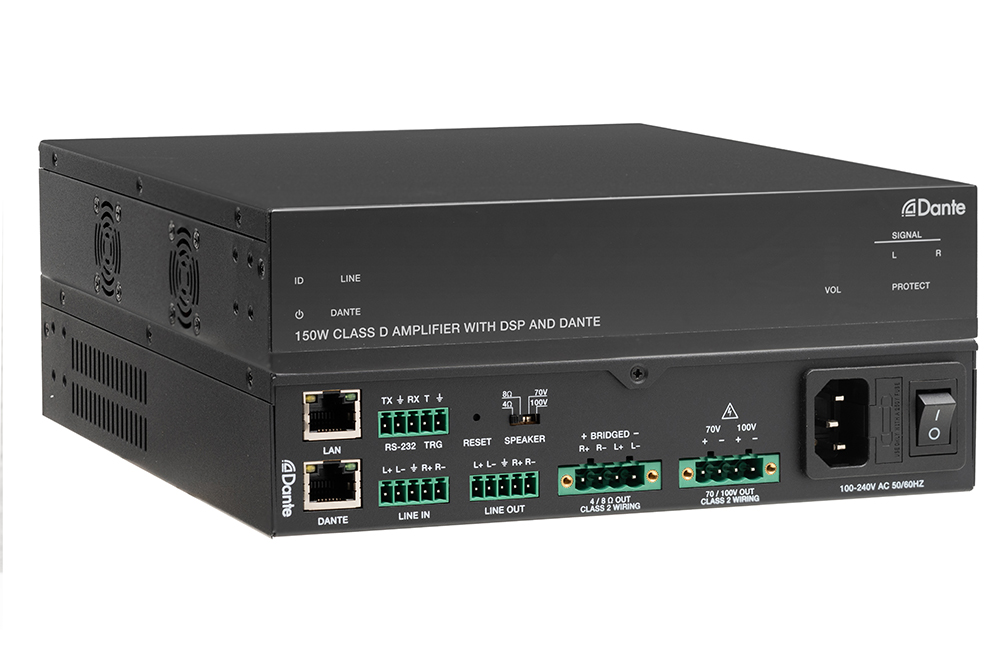
Setup Guide Configuring Your Network Switch for Dante Required switch settings for all KanexPro AUD-DTE- Dante products Dante requires a managed…
KanexPro sells direct to dealers, resellers, installers and integrators, and through distribution. Whichever way you buy, the same engineers answer the phone.
The trade store: your own account, live stock, reordering, and a first look at new products.
Go to the trade store →Distribution and authorised resellers across the US and beyond.
See where to buy →Design help on extenders, matrix and AV over IP before you spec it.
Ask an engineer →