Downloading KanexPro software and firmware safely
How KanexPro checks firmware and software downloads, how to verify a file's SHA-256 fingerprint, what the Windows SmartScreen warning means, and…


TCO Analysis, Deployment Scenarios & Conclusion
Continued from Part 1: architecture definitions, scalability, I/O flexibility, feature depth, and TAA compliance.
Fixed-configuration cost advantage is most pronounced at small scale (4×4 to 8×8). A modular chassis carries inherent overhead — chassis itself plus card selection. For a small, permanently stable deployment, fixed configuration may be the economically correct choice.
TCO shifts decisively toward modular when any of these occur: display count increases, display technology changes, feature requirements increase, or source count grows. Each requires hardware replacement for a fixed matrix but only a card addition or swap for modular.
The Hidden Cost: Forced Recabling. When a fixed matrix is replaced due to I/O growth, every cable must be disconnected and reconnected. With a modular chassis, only the new card's ports are cabled.
| Cost Factor | Fixed-Configuration | Modular (FLEX) |
|---|---|---|
| Initial purchase (small) | Lower | Higher (chassis overhead) |
| Initial purchase (medium/large) | Comparable | Comparable to lower |
| Expansion cost | Full chassis replacement + re-cable | Card purchase + 15-min install |
| I/O type change | External extenders or new chassis | Card swap |
| Video wall capability | External processor required | Built-in, no added cost |
| TAA compliance | Often not available | Standard on FLEX series |
Fixed-configuration remains appropriate when: the installation is small (under 8 I/O) and expansion is definitively not anticipated; budget is constrained and the fixed feature set meets all requirements; or the chassis form factor cannot be accommodated.
The choice is fundamentally a bet on stability. Fixed configuration bets the installation will never change. Modular architecture accepts that it will — and designs for it from day one. In most commercial AV installations where businesses grow and evolve, the modular bet wins.
The KanexPro FLEX Matrix provides modular I/O flexibility with built-in video wall, per-output scaling, quad view, CEC, REST API, and TAA compliance — in a chassis that grows with the installation without forced recabling and replacement cycles.
Contact KanexPro at support@kanexpro.com or 888.975.1368 for FLEX Matrix sizing assistance.
How KanexPro checks firmware and software downloads, how to verify a file's SHA-256 fingerprint, what the Windows SmartScreen warning means, and…
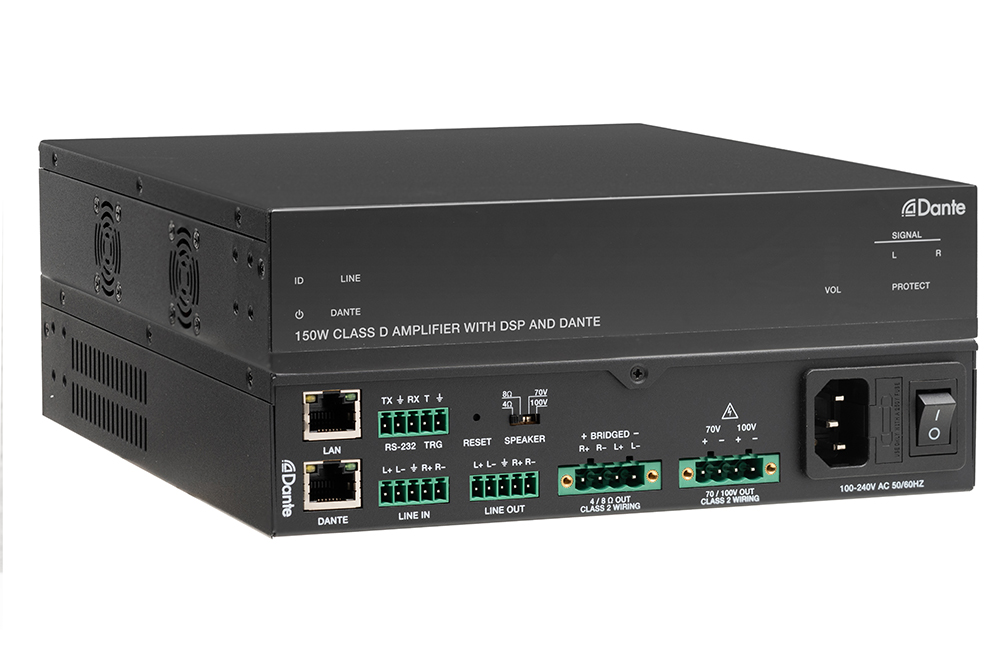
Boardrooms, conference rooms, campuses, lobbies — real-world deployment scenarios Corporate AV is among the most practical deployment target for…
Setup Guide Configuring Your Network Switch for Dante Required switch settings for all KanexPro AUD-DTE- Dante products Dante requires a managed…
KanexPro sells direct to dealers, resellers, installers and integrators, and through distribution. Whichever way you buy, the same engineers answer the phone.
The trade store: your own account, live stock, reordering, and a first look at new products.
Go to the trade store →Distribution and authorised resellers across the US and beyond.
See where to buy →Design help on extenders, matrix and AV over IP before you spec it.
Ask an engineer →